© CyNex Systems, All rights reserved. 2024
Industry-Inspired Hydraulic Training Systems
You are here: Cynex.ca
Educational & Laboratory Equipment - Industry-Inspired Hydraulic Training Systems
Popular Services:
Cynex Systems
Engineering. Manufacturing. Automation.
One Idea. One vision.
Turning possibilities into performance.
>> Get In Touch

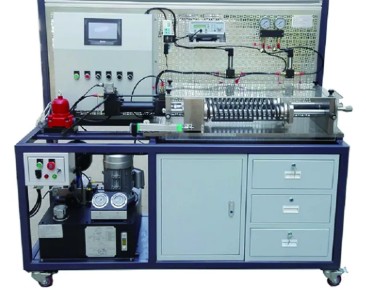
At Cynex Systems, we focus on industry-inspired hydraulic training systems designed to support engineering education, laboratory instruction, and hands-on learning at universities. These systems can help students understand the principles of hydraulic power, fluid behaviour, pressure regulation, and motion control, along with their applications in industrial machinery and automated equipment.
Hydraulic technology plays an important role in manufacturing, construction machinery, material handling, mobile equipment, and heavy-duty industrial systems. Through practical laboratory exercises, students can explore how hydraulic components work together to generate, control, and transmit power. Training systems can be adapted to university curricula, laboratory facilities, and specific educational objectives.
Engineering & Design Capabilities
Hydraulic training systems can incorporate industry-style components such as hydraulic pumps, reservoirs, cylinders, motors, directional control valves, pressure relief valves, flow control valves, filters, pressure gauges, and flow measurement devices. Depending on the learning requirements, systems may also integrate electrical controls, pressure sensors, programmable logic controllers (PLCs), and digital monitoring interfaces.
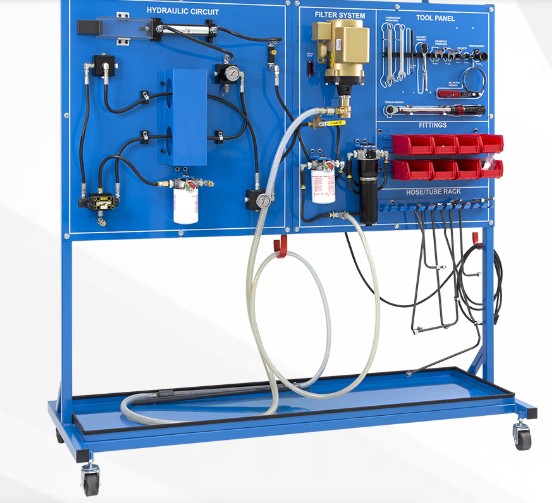
Components can be arranged in accessible laboratory workstations or modular training panels, allowing students to assemble circuits, observe system operation, and investigate the relationship between pressure, flow, force, and actuator speed. System configurations can range from fundamental hydraulic circuits to more advanced proportional control and electro-hydraulic applications.
Hands-On Learning & Experimental Activities
Hydraulic training systems can support practical exercises covering fluid power fundamentals, circuit design, pressure control, flow regulation, actuator operation, and load handling. Students can investigate how changes in system pressure and flow affect performance, observe the operation of different valve configurations, and compare alternative hydraulic circuit designs.
More advanced experiments may include electro-hydraulic control, sensor-based monitoring, proportional valves, PLC integration, and coordinated actuator movement. These activities can strengthen students’ understanding of hydraulic principles while developing practical skills in circuit interpretation, system analysis, troubleshooting, and performance evaluation.
Industry-Inspired Hydraulic Applications
Designed around concepts used in industrial and mobile machinery, hydraulic training systems can demonstrate applications such as lifting mechanisms, clamping systems, material handling, controlled linear motion, and hydraulic motor operation. Depending on the configuration, training equipment can also illustrate load control, pressure protection, and the operation of hydraulic systems under different working conditions.
By studying representative industrial applications, university students can better understand the role of hydraulic technology in high-force and heavy-duty operations. Practical exposure can also introduce important engineering considerations, including energy efficiency, system reliability, fluid cleanliness, component selection, maintenance, and operational safety.
Supporting University Teaching & Research
Hydraulic training systems can complement undergraduate engineering programs, mechanical engineering laboratories, mechatronics courses, and fluid power research. They can provide a practical foundation for laboratory experiments, student projects, demonstrations, and investigations into hydraulic system behaviour and control strategies.
Cynex Systems aims to support universities seeking adaptable training equipment that connects classroom theory with engineering practice. Depending on project requirements, systems may be customized to accommodate laboratory space, course content, student experience, and integration with complementary pneumatic, electrical, or automation training equipment.

- Engineering
- Manufacturing
- Mechatronics
- AI and Machine Vision
- Automation And Robotics